
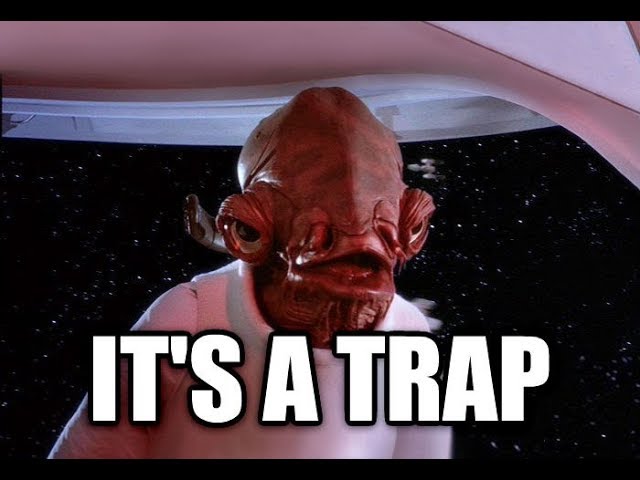

It’s a trap! is a line from Star Wars Episode VI: Return of the Jedi. The character Admiral Ackbar (Erik Bauersfeld), while engaging in an ambush on an enemy weapon, is informed that enemy ships have arrived.
Be aware of the deception
Technological lock-in occurs when users become dependent on a specific, often inferior or outdated, technology because the cost, effort, or inconvenience of switching to better alternatives is too high. Driven by path dependance, network effects, and high switching costs, this phenomenon causes industries and individuals to persist with established systems.
Plus, and worse, we are creatures of habit who seek routine and familiarity to feel safe.
In the context of digital software, the lock-in effect manifests itself in the form of obstacles that a platform can place on its users when exporting confidential data and information. The obstacles can be of various natures, and depending on their type, the phenomenon takes different forms:
-
- Technical lock-in: it occurs when a software prevents the export of its contained data
- Financial lock-in: it can be caused by contractual constraints that require data migration for a fee
- Organizational lock-in: it is related to the time and effort wasted in integrating years of work into a new platform from scratch
- Psychological lock-in: when, simply, switching to new software is hindered by habituation to the current software
Lock-in, therefore, limits the data management capabilities of professionals and companies, preventing them from accessing and archiving data outside the software they use.
Have you ever wondered how much freedom you actually have to manage your data and how transparent your software is about it?

Time to get serious and brave
So what can you do to avoid getting caught in a trap?
The risk of lock-in can be avoided by choosing software that guarantees transparency regarding data ownership and management, that does not require strictly binding contracts, and that can be freely integrated with other tools.
Choose software that is not outdated, that is constantly updated with scientific and regulatory updates, and that follows technological innovations in line with your needs.
The market is increasingly moving toward an open data perspective, which can allow professionals free access and the right to portability of their data.
Don’t get locked up into avoiding lock-in
Lock-in isn’t a simple true-or-false matter: avoiding being locked into one aspect often locks you into another. Also, popular notions, such as open source automagically eliminating lock-in, turn out to be not entirely true.
At first, the problem is silence: you know nothing.
Then the problem becomes the opposite: you know too much:
-
- Interesting feedback
- Sensible opinions
- Intelligent comments
- Everything seems relevant
- Everything seems like insight
But not everything “experts” tell you deserves equal weight.
The discovery phase, at this point, becomes an exercise in selection, not accumulation.
One of a software architect’s major objectives is to create options. Those options make systems change-tolerant, so we can defer decisions until more information becomes available or react to unforeseen events.
So my advice is: rely on the ones they give you options, not the ones they force you in one direction. And when you have to change, you aren’t just switching tools, you are evolving to a new software paradigm.
—–
Stay data-hungry. Stay data-foolish.
Your Friendly Neighborhood Digital Consultant






Well done on this article. The writing is clear, balanced, and easy to read. I especially appreciate the neutral approach, which allows the reader to focus on the information itself. Content like this feels trustworthy and well thought out.