
The BIC Pen, this humble writing instrument, is one of the most perfectly designed and ingeniously engineered products of the last century. The Bic Cristal, introduced in 1950, has become a universal tool for students, professionals, and everyday users. Its sheer simplicity, functionality, and affordability have cemented its status as a timeless design icon.
The Bic Cristal is a paragon of functional minimalism: a product so perfectly engineered that it remains unchanged decades later.
But unfortunately, we are not all like BIC.
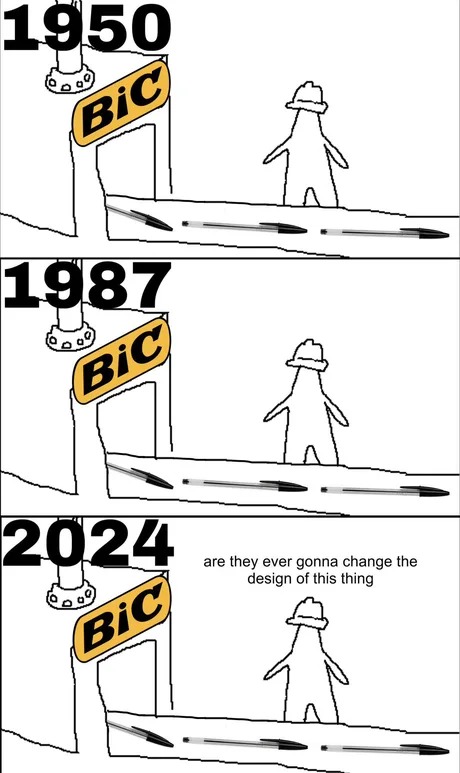
Businesses that never change face a harsh reality
In almost every industry, failing to adapt to shifting technology and consumer habits ultimately leads to obsolescence and failure.
Famous examples of once-dominant companies that were too slow to respond to change include:
-
-
- Blockbuster: They clung to their brick-and-mortar video rental model and rejected opportunities to embrace streaming, ultimately leading to bankruptcy
- Kodak: Despite inventing the first digital camera, management was too focused on the profitability of traditional photographic film and missed the digital revolution
- BlackBerry: They failed to anticipate the shift toward larger, touchscreen smartphones, focusing instead on physical keyboards while competitors took over the market
-
but also Polaroid, Toys R Us, Pan Am, Borders, Tower Records, Compaq and even General Motors no longer exist.
IKEA, instead, is leading the way.
They’ve just started closing 40-year megastores to target small urban shops and to focus on “phygital”, integrating physical and online shopping. It is a concrete sign of how world trade is changing. For decades, the IKEA model was perfect: take the car, spend hours in the megastore, live the complete experience. But today, consumers have changed: they want speed, simplicity, instant delivery, closer shopping points.
How many companies are still designing their business with customers of the past in mind?

Elite mentality isn’t just about winning
You’ve built a good enough company. You have developed good enough products. Competitors are trying to copy you, steal your customers, discredit you. You are actually at the top of the “food chain” of your industry and business. There is nothing else to do, you won. So why should you be worried?
Well, even when you are winning, be prepared. Everything can change in a minute. So, it’s not about winning, it’s about never being satisfied.
Let’s take this virtuous example. One of the things that separates Pep Guardiola (I love him…) from most football (soccer) managers is his obsession with improvement. Even after winning league titles, Champions Leagues, and building some of the greatest teams in football history, his focus is always the same: what can we do better tomorrow?
Players who work under Pep often say the same thing: the standards never drop. Every training session matters. Every detail matters. Every pass, movement, and decision is analyzed and improved. That’s what elite mentality looks like.
Not celebrating success for too long.
Not accepting “good enough”.
Always chasing the next level.
Because in football, like in business (not to mention software and digital business!), the moment you think you’ve made it… you’ve already stopped growing.

Converting a desktop application to a cloud service
In the last 10 years, one of the biggest challenges in the computer world was to shift from desktop to cloud concept.
For decades, the idea of computing was simple. You bought a computer, installed an operating system, stored your files locally, and used applications that ran directly on your hardware. The computer on your desk defined your computing experience.
A different model is emerging today. You can use a device with minimal internal power and connect to a shared virtual machine hosted in the cloud. Your processing, storage, and applications run remotely. Your local device becomes more like a window than the engine.
But have you ever stopped to think about what kind of hell software engineers must have gone through to make this leap forward in technology?
We tend to think that software houses are all equal, but they are not.
Small/medium digital companies are forced to pay and suffer a lot because of decisions made by giants like Microsoft, Autodesk, Amazon, and now OpenAI or Anthropic. When you have reached a stable point, these giants are putting on the table a ridiculous amount of money to move into the next big thing and users think that every company in digital business can afford it and give them new technologies for free. The reality is very different.

As NIN (Nine Inch Nails), an American industrial band formed by singer, songwriter, multi-instrumentalist, and producer Trent Reznor, explained very well in one of my favorite and beloved songs, this is just to say that on this journey, dear friends, we are not enemies:
You and meWe’re in this together nowNone of them can stop us nowWe will make it through somehow
—–
Stay data-hungry. Stay data-foolish.
Your Friendly Neighborhood Digital Consultant