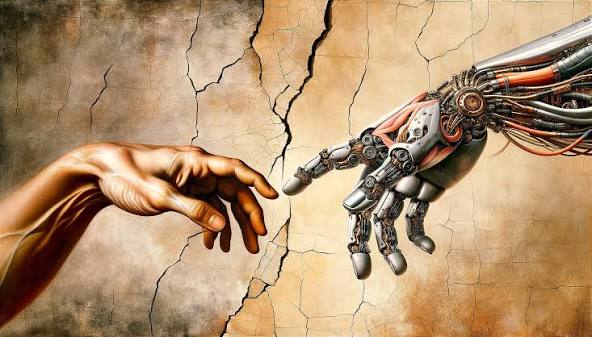

Twenty years ago, an idea cropped up that overreliance on technology might cause some kind of digital dementia resulting in the deterioration of short-term memory and other cognitive processes.
Three years ago, I forced myself to start learning LLMs first and using AI later, as often as possible. If I was going to be writing about it, I would also have to use this technology (that should be applied to any topic, right?).
Do Androids Dream of Electric Sheep?
All Watched Over By Machines Of Loving Grace, the famous cybernetic utopian poem by Richard Brautigan, published in 1967, envisions a harmonious, post-scarcity future where humans and nature are cared for by an omnipresent network of computers (full text here, if you are interested).
In Philip K. Dick’s 1968 dystopian novel, which inspired the movie Blade Runner, the “androids” (called Replicants) are biological rather than purely mechanical. The story explores whether creating artificial beings with implanted memories and emotions means they have souls, and whether humans treat them with the empathy they supposedly lack.
An internal IBM management training manual slide from 1979 has gone viral for its prescient warning about automation:
A computer can never be held accountable. Therefore a computer must never make a management decision.
While written during the 1970s mainframe boom to remind managers that technological data processing can never replace human judgements, futurists and tech executives note that the advice remains incredibly relevant.
After 45+ years of warning and concerns, in 2026, Italian Nobel laureate Giorgio Parisi and physicist Francesco Zamponi collaborated with the AI model Claude to solve a 10-year-old mathematical puzzle regarding “jamming” (the phenomenon where disordered particles suddenly lock into a rigid state). Parisi noted that while the AI provided brilliant intuitions, human guidance and oversight were essential to cross-verify the results.
Despite his embrace of AI as a research partner, he has continually warned against delegating decision-making to machines, and stressed that the final choices must always remain human.
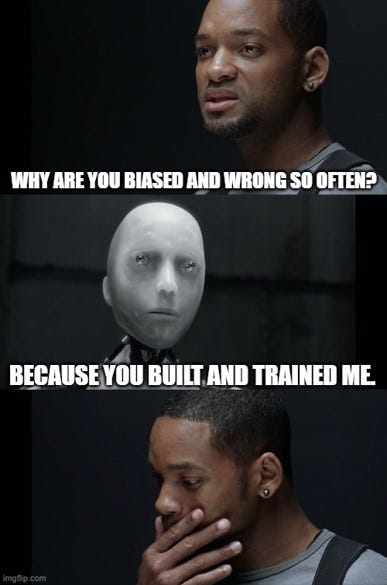
It is the simplest solutions which are usually the ones overlooked
Sir Arthur Conan Doyle’s famous insight in the Sherlock Holmes novel The Sign of the Four (released in 1890) is a big truth. Complexity often attracts us, leading us to underestimate the most logical and immediate answer. The obvious is often overlooked. When we focus on the complexity of a problem, the most immediate and effective answers inevitably elude us.
Here’s the thing: not every problem needs AI.
One of the best things I’ve picked up from the leaders around me isn’t a framework or a certification, it’s a habit. Before any project gets a green light, they ask two questions:
-
-
- Why are we doing this?
- What will it actually do to help?
-
Simple. Almost annoyingly simple. But it’s going to save me from building the wrong thing more than once.
It’s easy to reach for AI because it’s an exciting option. But sometimes the real answer is a flow, a validation rule, or a plain old automation: something deterministic, predictable, and a lot easier to govern.
AI earns its place when the task needs language understanding. Automation earns its place when the task is repeatable and the rules don’t change.
The vital question isn’t “Can we use AI here?”, it’s “Does this problem actually need what AI is good at?”.
People adopt tools they understand. A well-scoped automation that just works will always beat an AI agent that’s solving a problem nobody asked it to solve.
So before the next AI project kicks off, I’d rather spend five minutes on “why” than five weeks rebuilding it.
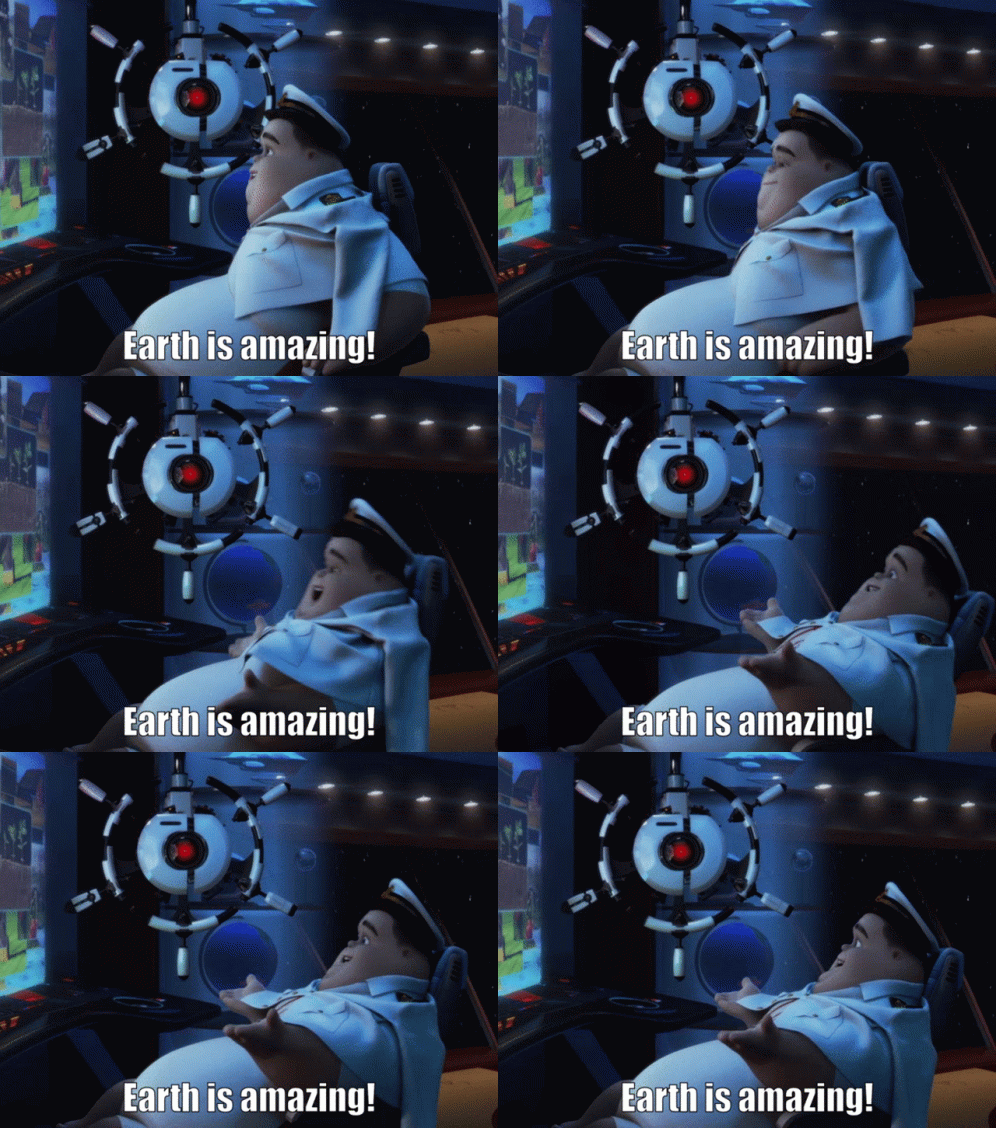
(PS: do me a favor and re-watch Pixar’s 2008 animated romantic science fiction movie WALL-E, directed by Andrew Stanton)
How to stop AI from turning your brain to mush
This isn’t all or nothing though.
Using AI doesn’t automatically mean it’s going to be bad for you. For example, if AI frees up your brain space for other more important things, that might be great for your cognition.
On the other hand, studies have found that people who rely on satellite navigation like GPS stop building mental maps of their surroundings and their spatial memory continues to decline over time.
My recommendation is to start from the basics.
My biggest fear is that the average person’s active vocabulary comprises around 6,500 words, compared to the tens of thousands found, for instance, in the Italian dictionary (which exceed 100,000 entries), although the core vocabulary used in everyday communication is further reduced to around 2,000 terms.
The poorer the language, the more thought disappears.
—–
Stay data-hungry. Stay data-foolish.
Your Friendly Neighborhood Digital Consultant