

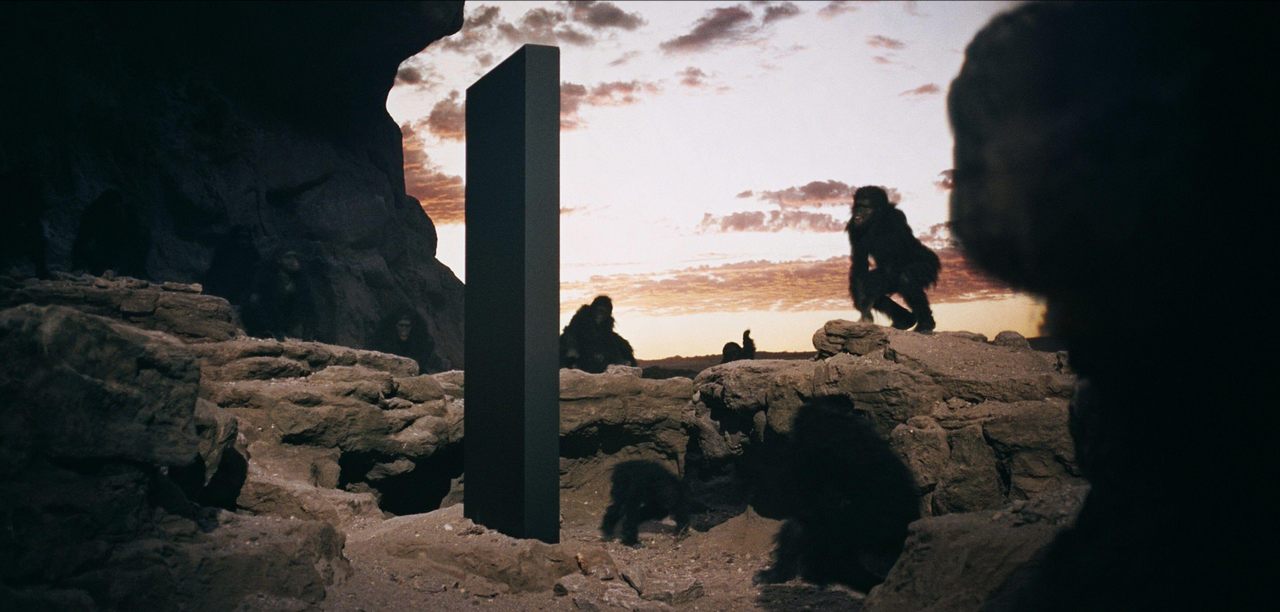
The picture below, taken from one of Kubrick’s masterpieces, is a clear representation of where we stand in the Foodservice Equipment and Supplies Industry when we are talking about a BIM file (RFA extension format name) of a single piece of equipment: a giant immutable monolith where all the professionals stare at like the Holy Grail.
Could anything be more wrong than this? I seriously doubt.
A data marketplace where nobody knows where to go
An information model (a BIM object), or more precisely, the distributed information system that constitutes it, does not evolve through clear-cut stages but through a series of phase transitions:
-
-
- Design
- Coordination
- Construction
- Operation
-
Just to mention the biggest phases, which are transformations of a single system, and they introduce new tensions and constraints that radically transform the model itself, or at least they should.
Every phase brings its own context: different software environments, data structures, sets of responsibilities, and meaning. A parameter that in the design phase expressed an intention (“this equipment requires a three-phase wall socket”) becomes a performance specification in construction and a maintenance attribute in operation.
Can we all agree on that, dear “BIM Presidents” of Whatever in the World? So can we please stop confusing Manufacturers by suggesting to the “monolith” approach? Oh, this is probably because you very well know that without a software solution (that you can’t offer), this is the only way to sell them something, am I right?
The monolithic approach is for the ones with no configurable equipment, a very small portion of Manufacturers, and yet we are covering just the geometry portion of the problem, because data is a completely different story, if you are selling worldwide.
It is also good for people that want to solve data requests from the market, thinking that BIM files are just like PDFs: “A customer asks for a file, we deliver a file”, hopefully with the fastest and minimum effort, to keep going to the next urgency.
Sorry to say that, by definition, a BIM file is a dynamic information environment, and not a static one. Plus, and more importantly:
Your BIM files are digital assets that value almost like your real equipment
“Candy Bag” vs Digital Twin
This is actually a perceived value problem. Because most of the time, digital assets are just a hassle and a waste of money in some people’s minds, only because they do not understand the value.
If you don’t want to do an extra step mentally, you are treating BIM files like you are buying immutable chairs. But this is not what BIM is all about.
So what do you really want:
-
-
- 100 immutable chairs to be delivered in one “candy bag” that you can send all-in-one and never know what people are doing with those, or
- 1 chair + 1 software that can build 100 (or more) combinations of chairs with structured data behind (an actual digital twin of the real chair)?
-
This is also the big difference in mindset between artisans and industries.
And it’s your choice.
Blue pill or red pill?
“This is your last chance. After this, there is no turning back. You take the blue pill – the story ends, you wake up in your bed and believe whatever you want to believe. You take the red pill – you stay in Wonderland and I show you how deep the rabbit hole goes.”
After 27 years, this quote, from the Wachowskis’ The Matrix, is as relevant today as it was then, and you can apply it to any situation, BIM included.
The blue pill is for people who think they know what they should do, because they trust professional titles of so-called experts (which, instead, I hate ’till death).
The red pill is for the ones who, before jumping to any conclusion about how BIM should work, want to start understanding PIM and software mechanisms before, even if there is no technical team in-house, because:
-
-
- there is no BIM for designers/consultants, without PIM (Product Information Management) logic for Manufacturers that have to provide their digital assets to them
- there is no configurability without any software, dynamic data, and a platform
-
The (right) platform always carries the hard part:
- the 3D engine
- the data infrastructure
- the security
Eighty percent of the work is already done before you start.
The barrier is never technical. The barrier is never you.
It is that nobody had built the floor (a software infrastructure) under you.
And building that floor is the one thing we have to prove we can do, as digital consultants.
—–
Stay data-hungry. Stay data-foolish.
Your Friendly Neighborhood Digital Consultant